
Education For Life Academy
Where Black History Lives!

The Standing on the Shoulders of Giants Curriculum


Christianity and the Roman Empire
Page 1 of 2
Nero, reign: 54 AD - 68 AD. Nero was rumored to have had captured Christians dipped in oil and set on fire in his garden at night as a source of light. This view is based on the writings of Tacitus, Suetonius and Cassius Dio, the main surviving sources for Nero's reign.

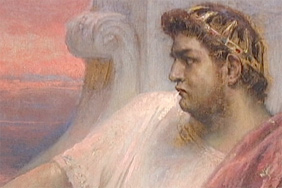
Depiction of Nero amusedly watching the torturing of Christians. He had their bodies burned to serve as torches for his evening affair.
Unit 1: Ancient Africa (200,000 B.C.E – 646 A.D.)
Class 10: Ancient Egypt: Greco-Roman Period (332 B.C. – 646 A.D. )
Since its inception, Christianity has had deep roots in Africa beginning with Mark the Evangelist who is credited with writing the Gospel of Mark of the New Testament. Mark is said to have founded the Church of Alexandria in Egypt in 41 AD, one of the most important episcopal sees of Early Christianity. His feast day is celebrated on April 25, and his symbol is the winged lion.
For the first 300 years Christianity was attacked by the Roman authorities as well as Jewish authorities. It was being practiced by the poor and downtrodden and its members talked of a savior who would soon come to establish a new kingdom for the righteous.
Nero Persecutes The Christians, 64 A.D.
A generation after the death of Christ, Christianity had reached Rome in the form of an obscure offshoot of Judaism popular among the city's poor and destitute. Members of this religious sect spoke of the coming of a new kingdom and a new king. These views provoked suspicion among the Jewish authorities who rejected the group and fear among the Roman authorities who perceived these sentiments as a threat to the Empire.
In the summer of 64, Rome suffered a terrible fire that burned for six days and seven nights consuming almost three quarters of the city. The people accused the Emperor Nero for the devastation claiming he set the fire for his own amusement. In order to deflect these accusations and placate the people, Nero laid blame for the fire on the Christians. The emperor ordered the arrest of a few members of the sect who, under torture, accused others until the entire Christian populace was implicated and became fair game for retribution. As many of the religious sect that could be found were rounded up and put to death in the most horrific manner for the amusement of the citizens of Rome. The ghastly way in which the victims were put to death aroused sympathy among many Romans, although most felt their execution justified.
Beginnings of Christian Martyrdom
The following account was written by the Roman historian Tacitus in his book Annals published a few years after the event. Tacitus was a young boy living in Rome during the time of the persecutions.
"Therefore, to stop the rumor [that he had set Rome on fire], he [Emperor Nero] falsely charged with guilt, and punished with the most fearful tortures, the persons commonly called Christians, who were [generally] hated for their enormities. Christus, the founder of that name, was put to death as a criminal by Pontius Pilate, procurator of Judea, in the reign of Tiberius, but the pernicious superstition - repressed for a time, broke out yet again, not only through Judea, - where the mischief originated, but through the city of Rome also, whither all things horrible and disgraceful flow from all quarters, as to a common receptacle, and where they are encouraged. Accordingly first those were arrested who confessed they were Christians; next on their information, a vast multitude were convicted, not so much on the charge of burning the city, as of "hating the human race."
In their very deaths they were made the subjects of sport: for they were covered with the hides of wild beasts, and worried to death by dogs, or nailed to crosses, or set fire to, and when the day waned, burned to serve for the evening lights. Nero offered his own garden players for the spectacle, and exhibited a Circensian game, indiscriminately mingling with the common people in the dress of a charioteer, or else standing in his chariot. For this cause a feeling of compassion arose towards the sufferers, though guilty and deserving of exemplary capital punishment, because they seemed not to be cut off for the public good, but were victims of the ferocity of one man."

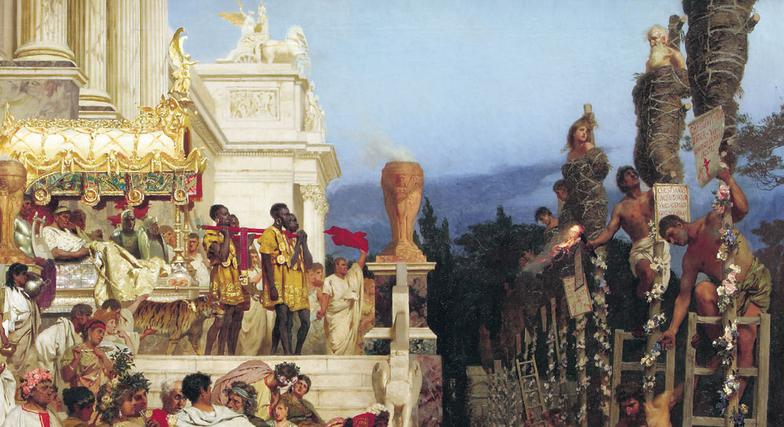
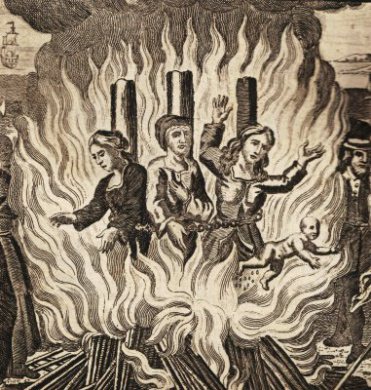
Depiction of Christian martyrs being burned at the orders of Nero. Nero burned Christian men, women, children and babies, yet mainstream media like wikipedia and the Library of Congress casually omit these deeds of Nero.
