
Education For Life Academy
Where Black History Lives!

The Standing on the Shoulders of Giants Curriculum
When Amenhotep III became pharaoh in 1390 BC, Egypt controlled a vast empire and was rich, respected and free. But it faced the challenge of powerful new rivals.
Rather than fighting these rivals, as his predecessors had done, Amenhotep III talked to them. The Amarna letters were small stone tablets - correspondence between the pharaoh and the leaders of rival nations. Instead of war, Egypt was now using diplomacy.
In its diplomacy, Egypt had one huge advantage. Its enormous quantities of gold made it the most valuable ally in the ancient world.
Foreign kings often asked Amenhotep for gold. The pharaoh was clever: although he gave them gold, he always left them wanting more. Amenhotep also used this wealth to start an extensive building program, which included enormous temples dedicated to himself and his chief queen, Tiy.
However, he was also growing tired of the power of the priests, particularly those of the chief god, Amen-Re. To keep the priests in their place, he began to pay attention to a minor god, Aten.
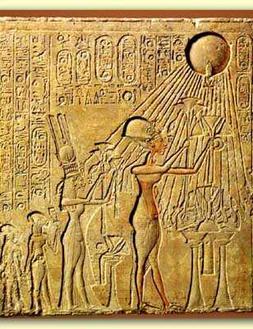
When he died, his son became pharaoh and took this religious change to extremes. He declared that Egypt would worship only one god, Aten, and closed down all the temples to Amen-Re.
The pharaoh then changed his name to Akenhaten and ordered a brand new capital city to be built at Amarna. Once completed, he packed up the city of Thebes and moved out.
After the death of his beloved wife, Nefertiti, Akenhaten ordered the destruction of all references to Amen-Re. He also lost touch with the outside world, ignoring the pleas of his people and allies and almost destroying Egypt's empire.
Source: PBS: Egypt's Golden Empire
Documentary: PBS: Egypt's Golden Empire: Pharaohs of the Sun

Unit 1: Ancient Africa (200,000 B.C.E. – 476 A.C.E.)
Amarna Art showing Akhenaten, Neretiti, and their children worshipping and being blessed by the Aten.
Class 11: Ancient Egypt: The New Kingdom and Third Intermediate Period Part 2
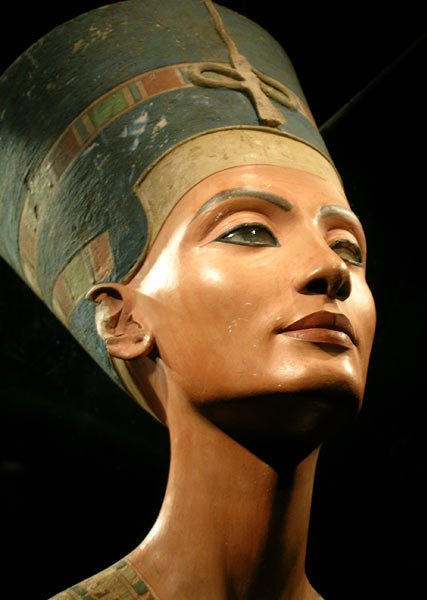
New Kingdom, Dynasty 18, ca. 1340 BC
Limestone, gypsum, crystal and wax
She was found in 1912 during the excavations of the German-Orient-Association in city of Achet-Aton, today known as Amarna. The individualized face and the special crown, tall, flat-topped decorated with a ribbon and the remains of a uraeus at the front identify the statue as Nefertiti. The bust served , as did many other masks found in the workshop of the Tuthmosis, as a model for artists producing portraits of the queen.
