
Education For Life Academy
Where Black History Lives!

The Standing on the Shoulders of Giants Curriculum
RAMESES AS PHARAOH OF EXODUS
Although Ramesses has been popularly associated with the pharaoh of the biblical Book of Exodus, there is absolutely no evidence to support this claim. The association of the name `Ramesses' with the unnamed pharaoh of Egypt in the Bible became quite common after the success of Cecil B. DeMille's film The Ten Commandments in 1956. Film versions of the biblical story since, including the popular animated film Prince of Egypt (1998) and the more recent Exodus: Gods and Kings (2014) both followed the lead of DeMille's film but there is no historical support for this association.
Extensive archaeological excavations at Giza and elsewhere throughout Egypt have unearthed ample evidence that the building projects completed under the reign of Ramesses II (and every other king of Egypt) used skilled and unskilled Egyptian laborers who were either paid for their time or who volunteered as part of their civic duty. The custom of Egyptian citizens volunteering their time to work on the king's building projects is well documented and it was even thought that, in the afterlife, souls would be called upon to work for Osiris, Lord of the Dead, on the building projects he would want. The practice of placing shabti dolls in the tombs and graves of the dead was precisely for this purpose: so the dolls would take the place of the deceased in work projects.
Further, Ramesses was famous for recording histories of his accomplishments and for embellishing the facts when they did not quite fit history as he wished it preserved. It seems highly unlikely that such a king would neglect to record (with or without a favorable slant) the plagues which allegedly fell upon Egypt or the flight of the Hebrew slaves. One need not rely solely on the inscriptions Ramesses himself ordered, however; the Egyptians, from the time they mastered writing c. 3200 BCE, kept very extensive records and none of them even hint at a large population of Hebrew slaves in Egypt much less their mass exodus. The association of Ramesses with the cruel, stubborn pharoah of Exodus is unfortunate as it obscures the character of a man who was a great and noble ruler.
LEGACY
The reign of Ramesses II has become somewhat controversial over the last century with some scholars claiming he was more of a showman and a propagandist than and effective king and others arguing the opposite. The records of his reign, however - both the written and the physical evidence of the temples and monuments - argue for a very stable and prosperous reign. He was one of the few rulers to live and rule long enough to take part in two Heb Sed festivals which were held every thirty years to rejuvenate the pharaoh. He secured the country's borders, increased its wealth, and widened its scope of trade and, if he boasted of his accomplishments in his inscriptions and monuments, it is becaue he had good reason to be proud.
Ramesses the Great’s mummy shows that he stood over six feet in height with a strong, jutting jaw, thin nose and thick lips. He suffered from dental problems, severe arthritis, and hardening of the arteries and, most likely, died from old age or heart failure. He was known to later Egyptians as the 'Great Ancestor’ and many pharaohs would do him the honor of taking his name as their own. Some of them, such as Ramessess III, are considered better rulers than he was; none of them, however, would surpass the grand achievements and glory of Ramesses the Great in the minds and hearts of the ancient Egyptians.
Source:
Joshua J. Mark, “Ramesses II,” Ancient History Encyclopedia, last modified September 02, 2009, http://www.ancient.eu /Ramesses_II/.


Pharaoh Rameses the Great, 19th Dynasty (1292-1186 BCE)
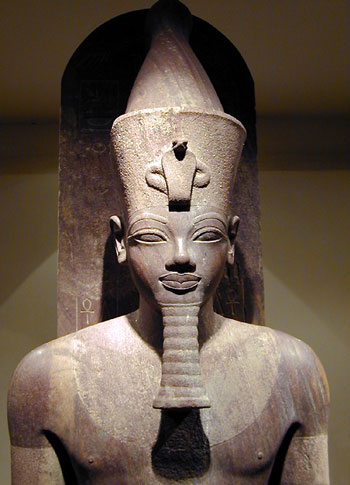
Pharaoh Amenhotep III, 18th Dynasty, Reign: June 1388 BC to December 1351

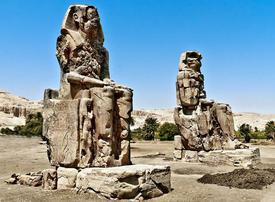
Colossi of Memnon. The twin statues depict Pharaoh Amenhotep III in a seated position, his hands resting on his knees and his gaze facing eastwards towards the river. They once stood at the entrance gate of Amenhotep's memorial temple, a massive construct built during the pharaoh's lifetime, where he was worshipped as a god-on-earth. Click for pictures and learn why they were once called the "Singing Statues."
Unit 1: Ancient Africa (200,000 B.C.E. – 476 A.C.E.)
Page 3 of 3

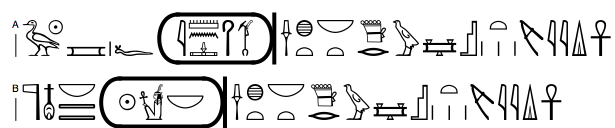
Son of Re beloved by him (Amenhotep, Ruler of Thebes)|, beloved by Sakhmet, Lady of the Limits of Places, given life. Young God, Lord of the Two Lands, (Nebmaatre)|, beloved by Sakhmet, Lady of the Limits of Places, given life.
Text on statue at State Hermitage Museum:
Class 12: Ancient Egypt: The New Kingdom and Third Intermediate Period Part 3
