
Education For Life Academy
Where Black History Lives!

The Standing on the Shoulders of Giants Curriculum



Class Overview cont.
Greek Historian, Polybius (200 - 118 B.C.E.). Much of what we know about Hannibal came from Polybius' Histories, which you can read here. Polybius was on the battlefield as a historian when Rome fought Hannibal.

Unit 1: Ancient Africa (200,000 B.C.E. – 476 A.C.E.)
Class 16: Hannibal Barca – Defender of Carthage (247 B.C.E. – 181/183 B.C.E.)

supported the African Holocaust created the ideology of racism, declaring that Africans had no history, contributed nothing to civilization and had been living in a state of barbarism since their existence. African Civilizations such as ancient Kemet/Egypt were all of a sudden attributed to some mythical and extinct “Mediterranean/Asiatic/White race,” even as the images on the walls of the pyramids, monuments and papyri clearly depict dark-skinned black Africans with unmistakable African features such as wide noses, thick lips, and wooly hair.
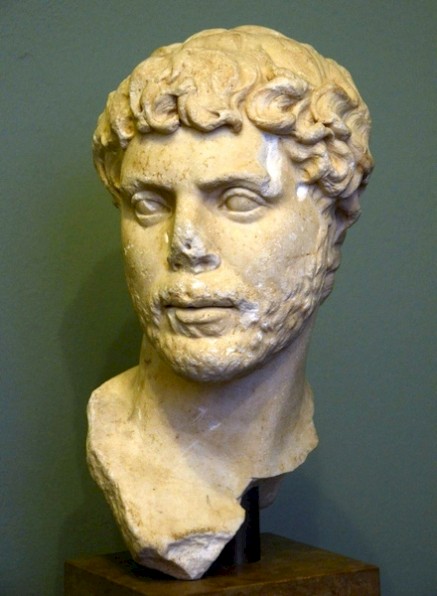
While there are no physical images of Hannibal, his father or his brother, there is no reason to believe that he was anything other than African and all that that entails, including having dark skin. However, virtually all modern images of Hannibal depict him as European. White historians and racists have no problem with White images of Hannibal. Yet they vehemently reject any African depictions of Hannibal, even though he was born in Africa and as I stated, there is no physical proof of his “race” either way.
By the time Hannibal was born, Carthage, located in the heart of North Africa, was 500 years old. Although it was originally a Phoenician colony, Carthage had absorbed the indigenous Africans already inhabiting the territory. In his book, Daily Life in Carthage at the Time of Hannibal, Charles Picard reports:
"The anthropological examination of skeletons found in tombs in Carthage proves that there is no racial unity [...] The so called Semitic type, characterized by the long, perfectly oval face, the thin aquiline nose and the lengthened cranium, enlarged over the nape of the neck has not been found in Carthage. On the other hand, another cranial form, with a fairly short face, prominent parietal bumps, farther forward and lower down than is usual is common [...] most of the Punic population in Carthage had African and even Negro ancestors."
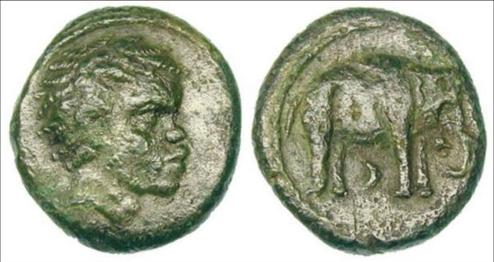
Furthermore, Africans constituted large numbers of the Carthaginian army, which lends support to Hannibal’s African ethnicity. Lastly, there exist silver coins from Carthage that clearly depict an African, whom many believe to be Hannibal or his father. These coins, which you will view in this class, show an unmistakable African with African features such as wooly hair and a broad nose. There is no other indigenous “African” Carthaginian of that era who would have welded such esteem as to have his face minted on a coin. Another telling piece of evidence as to Hannibal’s Africanity is how certain modern Hollywood movies and documentaries (which you will see in this class) reluctantly acknowledge that Hannibal was a “black African.” Even Anheuser-Busch commissioned a “Great Kings & Queens of African series” in 1981 which depict Hannibal as a full-fledged Black African. In short, there is far more evidence that support the fact that Hannibal was a “black” African as opposed to a “white” African, which is why he is included in the Standing on the Shoulders of Giants Black history curriculum.
Page 2 of 2

Coin from ancient Carthage believed to be of Hannibal. As you can see, the face on the front of the coin is clearly African and the back of the coin is an elephant, which Hannibal is famous for using against the Romans. The coin was minted during Hannibal's time. This is solid proof that Hannibal was a Black African.




Titus Livius (Livy), The War with Hannibal from The History of Rome, Book 21
