
Education For Life Academy
Where Black History Lives!

The Standing on the Shoulders of Giants Curriculum

Unit 1: Ancient Africa (200,000 B.C.E. – 476 A.C.E.)
Class 7: Ancient Egypt: Predynastic Period & The Old Kingdom (10,500 – 2181 B.C.E.)
Ancient Kemetic/Egyptian God Index
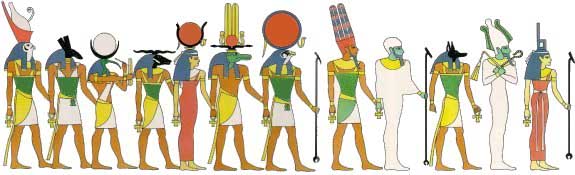
Human and semihuman forms of some of the chief Kemetic/Egyptian deities: 1) Horus, son of Osiris, a sky god closely connected with the king. 2) Set, enemy of Horus and Osiris, god of storms and disorder. 3) Thoth, a moon deity and god of writing, counting and wisdom. 4) Khnum, a ram god who shapes men and their kas on his potter's wheel. 5) Hathor, goddess of love, birth and death. 6) Sobek, the crocodile god, Lord of the Faiyum. 7) Ra, the sun god in his many forms. 8) Amon, a creator god often linked with Ra. 9) Ptah, another creator god and the patron of craftsmen. 1O) Anubis, god of mummification. 11) Osiris, god of agriculture and ruler of the dead. 12) Isis, wife of Osiris, mother of Horus and Mistress of Magic.
There were at least three separate cosmogenies in Egyptian mythology, corresponding to at least two separate groups of worshippers.1. The Ennead, in which Atum arose from the primordial waters (Neith), and masturbated to relieve his loneliness. His semen and breath became Tefnut (moisture) and Shu (dryness), respectively. From Shu and Tefnut, were born Geb (earth), and Nut (sky), who were born in a state of permanent copulation. Shu separated them, and their children were Ausare (Osiris; death), Set (desert), Aset (Isis; life), and Nebet Het (Nephthys; fertile land). Osiris and Isis were a couple, as were Nepthys and Set.
Over time, the rival groups gradually merged, Ra and Atum were identified as the same god, making Atum's mysterious creation actually due to the Ogdoad, and Ra having the children Shu and Tefnut, etc. In consequence, Anubis was identified as a son of Osiris, as was Horus. Amun's role was later thought much greater, and for a time, he became chief god, although he eventually became considered a manifestation of Ra.
For a time, Ra and Horus were identified as one another, and when the Aten monotheism was unsuccessfully introduced, it was Ra-Horus who was thought of as the Aten, and the consequent cosmogony this inspired. Later, Osiris' cult became more popular, and he became the main god, being identified as a form of Ptah. Eventually, all the gods were thought of as aspects of Osiris, Isis, Horus, or Set (who was by now a villain), indeed, Horus and Osiris had started to become thought of as the same god. Ptah eventually was identified as Osiris.
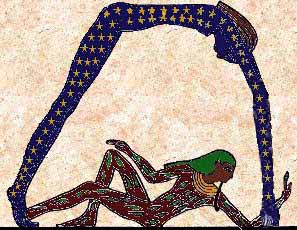
Nut - pronounced Noot - was the Egyptian goddess of the sky and of the heavens. She was the daughter of the air god, Shu and water goddesses, Tefnut. Nut was typically depicted as a woman with blue skin - her body covered with stars - standing on all fours - leaning over her husband, Geb - representing the sky arched over the Earth.
Creation Myths (please note, these tales contain material with sexual references)
In the beginning, before there was any land of Egypt, all was darkness, and there was nothing but a great waste of water called Nun. The power of Nun was such that there arose out of the darkness a great shining egg, and this was Re. He was all-powerful, and he could take many forms. His power and the secret of it lay in his hidden name; but if he spoke other names, that which he named came into being.
"I am Khepera at the dawn, and Re at noon, and Tem in the evening," he said. And the sun rose and passed across the sky and set for the first time.
Then he named Shu, and the first winds blew; he named Tefnut the spitter, and the first rain fell. Next he named Geb, and the earth came into being; he named the goddess Nut, and she was the sky arched over the earth with her feet on one horizon and her hands on the other; he named Hapi, and the great River Nile flowed through Egypt and made it fruitful.
Creation Myth 2
Page 1 of 4
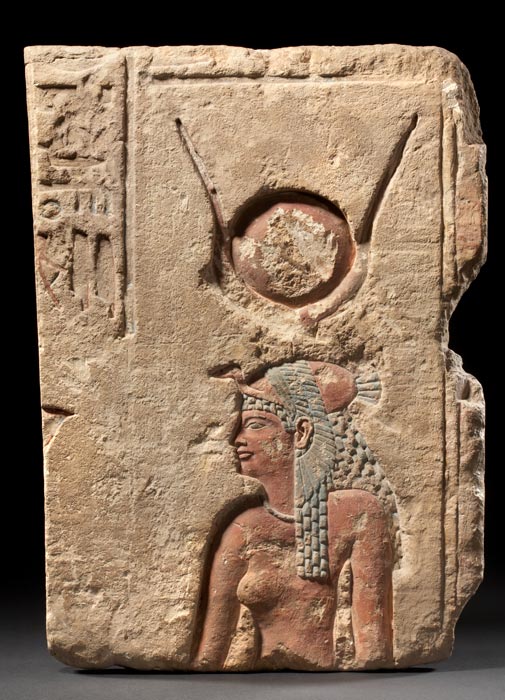
Relief of Goddess Hathor. Hathor is the ancient Kemetic goddess who personified the principles of love, beauty, music, dance, motherhood and joy. She is one of the oldest and most important deities, appearing before the 1st Dynasty. Hathor's symbol is the cow, which represents fertility, and nature in general. She was worshiped by royalty and common people alike in whose tombs she is depicted as "Mistress of the West" welcoming the dead into the next life.

2. The Ogdoad, in which Ra arose, either in an egg, or a blue lotus, as a result of the creative interaction between the primordial forces of Nu/Naunet (water), Amun/Amunet (air), Kuk/Kauket (darkness), and Huh/Hauhet (eternity). Ra then created Hathor, his wife, with whom they had a son, Hor (Horus; in the form known as Horus the Elder), who was married to Isis. This cosmogony alsonincludes Anupu (Anubis) as lord of the dead, amongst others.There were at least three separate cosmogenies in Egyptian mythology, corresponding to at least two separate groups of worshippers.
