
Education For Life Academy
Where Black History Lives!

The Standing on the Shoulders of Giants Curriculum
THE 42 LAWS OF MA'AT
1. I have not committed sin.
I have not committed sin.2.I have not committed robbery with violence.
I have not committed robbery with violence.3.I have not stolen.
I have not stolen.4.I have not slain men or women.
I have not slain men or women.5.I have not stolen food.
I have not stolen food.6.I have not swindled offerings.
I have not swindled offerings.7.I have not stolen from God/Goddess.
I have not stolen from God/Goddess.8.I have not told lies.
I have not told lies.9.I have not carried away food.
I have not carried away food.10.I have not cursed.
I have not cursed.11.I have not closed my ears to truth.
I have not closed my ears to truth.12.I have not committed adultery.
I have not committed adultery.13.I have not made anyone cry.
I have not made anyone cry.14.I have not felt sorrow without reason.
I have not felt sorrow without reason.15.I have not assaulted anyone.
I have not assaulted anyone.16.I am not deceitful.
I am not deceitful.17.I have not stolen anyone’s land.
I have not stolen anyone’s land.18.I have not been an eavesdropper.
I have not been an eavesdropper.19.I have not falsely accused anyone.
I have not falsely accused anyone.20.I have not been angry without reason.
I have not been angry without reason.21.I have not seduced anyone’s wife.
I have not seduced anyone’s wife.22.I have not polluted myself.
I have not polluted myself.23.I have not terrorized anyone.
I have not terrorized anyone.24.I have not disobeyed the Law.
I have not disobeyed the Law.25.I have not been exclusively angry.
I have not been exclusively angry.26.I have not cursed God/Goddess.
I have not cursed God/Goddess.27.I have not behaved with violence.
I have not behaved with violence.28.I have not caused disruption of peace.
I have not caused disruption of peace.29.I have not acted hastily or without thought.
I have not acted hastily or without thought.30.I have not overstepped my boundaries of concern.
I have not overstepped my boundaries of concern.31.I have not exaggerated my words when speaking.
I have not exaggerated my words when speaking.32.I have not worked evil.
I have not worked evil.33.I have not used evil thoughts, words or deeds.
I have not used evil thoughts, words or deeds.34.I have not polluted the water.
I have not polluted the water.35.I have not spoken angrily or arrogantly.
I have not spoken angrily or arrogantly.36.I have not cursed anyone in thought, word or deeds.
I have not cursed anyone in thought, word or deeds.37.I have not placed myself on a pedestal.
I have not placed myself on a pedestal.38.I have not stolen what belongs to God/Goddess.
I have not stolen what belongs to God/Goddess.39.I have not stolen from or disrespected the deceased.
I have not stolen from or disrespected the deceased.40.I have not taken food from a child.
I have not taken food from a child.41.I have not acted with insolence.
I have not acted with insolence.42.I have not destroyed property belonging to God/Goddess
I have not destroyed property belonging to God/Goddess Unit 1: Ancient Africa (200,000 B.C.E. – 476 A.C.E.)
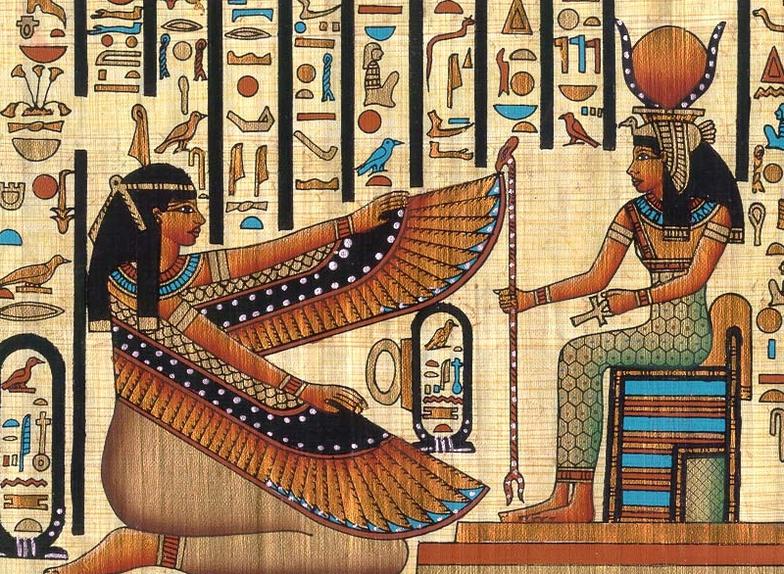
Maat or Ma'at is the ancient Kemetic/Egyptian concept of truth, balance, order, law, morality, and justice. Ma'at is represented as a goddess with wings. She is the symbol of the moral and carnal laws of ancient Kemet and one of the most important of all the gods. She put order to the universe at the time of creation and is responsible for regulating the stars, seasons, and the actions of both mortals and deities. Through the 42 Laws of Ma'at she provides the moral and ethical guidelines in which all Egyptian citizens were to follow in order to achieve rebirth in the afterlife. Aside from her role in creation, Ma'at played a critical role in the weighing of the soul that took place in the Duat, or the underworld. In order to achieve reincarnation, one's soul had to be "light as a feather" after reciting the 42 Laws of Ma'at before Osiris.
Although the first mention of Ma'at is found in the pyramid of Unas of the 5th Dynasty, ca. 2450 B.C.E., we know that the laws of Ma'at were formulated well before the establishment of ancient Egypt. Pharaohs were often depicted with adornments representing Ma'at, illustrating their pharaonic responsibility and commitment to upholding her principles. The entire spiritual foundation of ancient Kemet/Egypt was based on the principles set forth by a woman.
Class 7: Ancient Egypt: Predynastic Period & The Old Kingdom (10,500 – 2181 B.C.E.)
The Goddess and Concept of MA'AT
Ma'at with Isis. Isis and Osiris were charged with upholding the laws of Ma'at in order to prevent the universe from chaos and disorder.
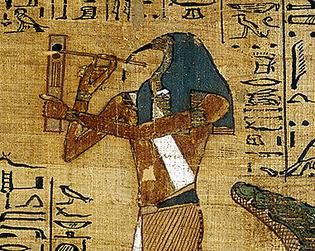
The God Djehuty, or Thoth. Thoth is the male counterpart to Ma'at. Together they maintain the balance of the universe. Thoth is also the God associated with writing and philosophy. He is who the very word "thought" is derived from. He is usually depicted as an ibis-headed man, often in the occupation of a scribe or recorder of events.
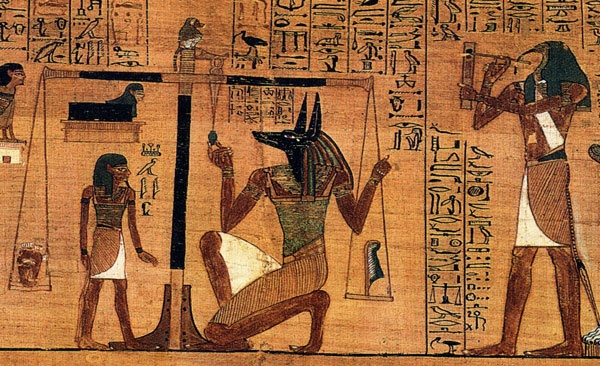
Scene from "the Weighing of the Heart/Soul." On the left scale is one's heart and the right sits the feather of Ma'at, which symbolizes purity or "lightness" of heart. In order to receive reincarnation, one's heart had to be "as light a feather."

* Laws bolded in orange are virtually identical to the 10 Commandments handed down by Moses 2,000 years later.
