
Education For Life Academy
Where Black History Lives!

The Standing on the Shoulders of Giants Curriculum




Why Africana History? cont.

Class 1: African History: The Missing Pages of World History
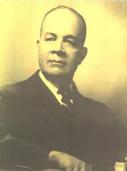
(1883 to 1966)
Pioneering African Historian and Author. His Two-Volume Work, World's Great Men of Color stands as a classic.
Page 3 of 3
when public attention should be focused on the achievements of America's citizens of African descent.
The acceptance of the facts of African-American history and the African-American historian as a legitimate part of the academic community did not come easily. Slavery ended and left its false images of Black people intact.
Early white American historians did not accord African people anywhere a respectful place in their commentaries on the history of man. In the closing years of the nineteenth century, African-American historians began to look at their people's history from their vantage point and their point of view. Dr. Benjamin Quarks observed that "as early as 1883 this desire to bring to public attention the untapped material on the Negro prompted George Washington Williams to publish his two-volume History of The Negro Race in America from 1619 to 1880. The first formally trained African-American historian was W.E.B. DuBois, whose doctoral dissertation, published in 1895, The Suppression Of The African Slave Trade To The United States, 1638-1870, became the first title to be published in the Harvard Historical Studies. It was with Carter G. Woodson, another Ph.D., that African world history took a great leap forward and found a defender who could document his claims. Woodson was convinced that unless something was done to rescue the Black man from history's oversight, he would become a "negligible factor in the thought of the world. " Woodson, in 1915, founded the Association for the Study of Negro Life and History. Woodson believed that there was no such thing as, "Negro History. " He said what was called "Negro History" was only a missing segment of world history. He devoted the greater portion of his life to restoring this segment.
Africa came into the Mediterranean world, mainly through Greece, which had been under African influence, and then Africa was cut off from the melting pot by the turmoil among the Europeans and the religious conquests incident to the rise of Islam. Africa, prior to these events, had developed its history and civilization, indigenous to its people and lands. Africa came back into the general picture of history through the penetration of North Africa, West Africa and the Sudan by the Arabs. European and American slave traders next ravaged the continent. The imperialist colonizers and missionaries finally entered the scene and prevailed until the recent re-emergence of independent African nations.
Africans are, of course, closely connected to the history of both North and South America. The African-American's role in the social, economic and political development of the American states is an important foundation upon which to build racial understanding, especially in areas in which false generalization and stereotypes have been developed to separate peoples rather than to unite them. Contrary to a misconception which still prevails, the Africans were familiar with literature and art for many years before their contact with the Western World. Before the breaking-up of the social structure of the West African states of Ghana, Mali and Songhay and the internal strife and chaos that made the slave trade possible, the forefathers of the Africans who eventually became slaves in the United States, lived in a society where university life was fairly common and scholars were held in reverence.
To understand fully any aspect of African-American life, one must realize that the African-American is not without a cultural past, though he was many generations removed from it before his achievements in American literature and art commanded any appreciable attention. Africana, or Black History, should be taught every day, not only in the schools, but also in the home. African History Month should be every month…
The late Dr. John Henrik Clarke was a pre-eminent African-American historian, author of several volumes on the history of Africa and the Diaspora. He taught in the Department of Black and Puerto Rican Studies at Hunter College of the City University of New York.
Originally published in THE BLACK COLLEGIAN Magazine (1997).
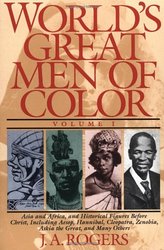
World’s Great Men of Color is the comprehensive guide to the most noteworthy Black personalities in world history and their significance. J.A. Rogers spent the majority of his lifetime pioneering the field of
Black studies with his exhaustive research on the major names in Black history whose contributions or even very existence have been glossed over. Also see Volume II!
Go to Google Books to read the Introduction to the book by John Henrik Clarke and other sections for free before purchasing

Intro Unit: The Politics of Education – Enlightenment or Propaganda?
