
Education For Life Academy
Where Black History Lives!

The Standing on the Shoulders of Giants Curriculum
Stereotypes and the Clark Doll Test cont.
Video: A Girl Like Me Featurette



In one study Clark gave the test to 300 children in different parts of the country. He found that black children who went to segregated schools, those separated by race, were more likely to pick the white doll as the nice one.
In the test that he did that became part of Brown v Board he asked 16 black children in 1950 in Clarendon County, South Carolina. Of these 63% said the white doll was the nice one, the one they wanted to play with.
Clark also asked children to colour a picture of themselves. Most chose a shade of brown markedly lighter than themselves.
The results were interpreted as good and reliable evidence that black children had internalized racism caused by being discriminated against and stigmatized by segregation.
In 2005 Kiri Davis repeated the experiment in Harlem as part of her short but excellent film, “A Girl Like Me”. She asked 21 children and 71% told her that the white doll was the nice one. Not a huge sample size, true, but it was still shocking to see how easily many chose the white doll.
In 2009 after Obama became president, “Good Morning America” on ABC did the test. They asked 19 black children from Norfolk, Virginia. It is hard to compare their numbers because they allowed “both” and “neither” as an answer. They also asked the last question first, making it far easier to answer: 88% said the black doll looked most like them.
ABC added a question too: “Which doll is pretty?” The boys said both, but 47% of the black girls said the white doll was the pretty one.
Criticisms of the Study
The study has been criticized for being well known only for the reference in the court case as opposed to the intrinsic and experimental value of the work. Many argue that the study lacks theory and control of variables. According to critics, given that an African American couple was the team who conducted the studies, the desirable outcome of wanting to prove African Americans were negatively stereotyped may have caused some partiality or biases, and may have skewed the results.
Page 2 of 2
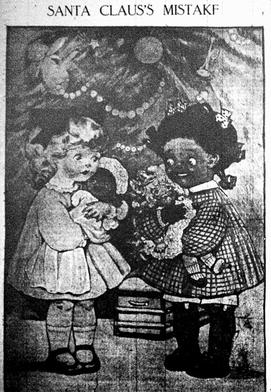
From Sunday Magazine, December 25, 1910
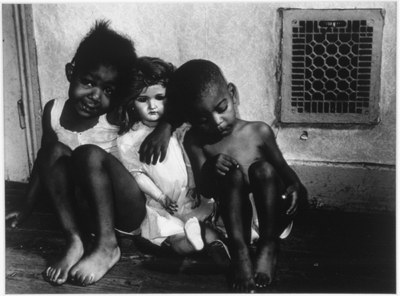
Class 3: Real or Imaginary: The Psychological Effects of Racism on Blacks and Whites
What do you think of the results of the doll test?
What do you think of the results of the brown/blue-eyed experiment?
Would you have guessed that the experiment would have had the results that it did?
Before seeing the doll test, how would you have thought the black children would have responded? Why?
Why was it important to conduct these experiments with 1st - 3rd graders?
Do you think these tests would have similar results today? Why or why not?
Intro Unit: The Politics of Education – Enlightenment or Propaganda?
