
Education For Life Academy
Where Black History Lives!

Unit 3: The Trans-Atlantic Slave Trade & African Colonialism (1400 – 1865)
The Standing on the Shoulders of Giants Curriculum



Class Overview

- Understand the conditions that led to the Haitian Revolution
- Identify the main leaders of the Haitian Revolution and highlight the role each played
- Describe the international significance of the Haitian Revolution
- Discuss the relationship between the French Revolution and the Haitian Revolution as well as the benefits and consequences of a Black-led revolt



Class 4: The Haitian Revolution (1791 – 1804)
Page 1 of 2
In 1804, on the heels of the French Revolution, the Republic of Haiti emerged as the first Black nation in the Western hemisphere. Not only did Africans successfully overthrow the institution of slavery, they also ended French colonial rule. This event sent shockwaves throughout the entire Western world. It instilled fear in slave-owners far and wide, and it inspired hope among enslaved populations who staged their own rebellions against slavery, including slave revolts in Louisiana and Virginia. Led by Toussaint L’Ouverture, Henri Christophe, and Jean-Jacques Dessalines, the Haitian Revolution achieved what many thought to be virtually impossible—the eradication of white domination.
European Conquest and the Enslavement of Africans
Haiti was originally named Ayiti, one of the names given to the land by the indigenous Taíno people of the Arawakan nation. The entire island, which constituted modern day Haiti and Dominican Republic, was invaded by Christopher Columbus in 1492 under the sponsorship of the Spanish Crown who renamed the island La Isla Española, later named Hispaniola. The Spanish conquest was so destructive, the indigenous population declined from a half million to roughly 60,000 over the course of 15 years. The devastation and murder of the native population led to the importation of enslaved Africans in the early 1500s.
It was not until 1695 that the French finally won legal rights to the Western part of Hispaniola (modern day Haiti), which they renamed Saint-Domingue. The French had been in fierce competition with Spain and Britain for control over the island. To fuel their new colony, the French kidnapped thousands of Africans and transported them to Saint-Domingue. In 1701 there were approximately 20,000 slaves on the island. By 1790, there were 500,000 enslaved Africans and 30,000 whites. Saint Domingue also had the largest and wealthiest population of free people of color, most of whom were bi-racial, totaling roughly 25,000 people. Like many slave societies, enslaved Africans outnumbered the white ruling class by far, which led to extremely brutal practices and strict laws to maintain white domination.
Undoubtedly, Saint-Domingue was a goldmine for the development of modern Western nations. The production of coffee, sugar, tobacco, indigo and cotton by enslaved Africans was the backbone of the French economy and the rise of global capitalism.
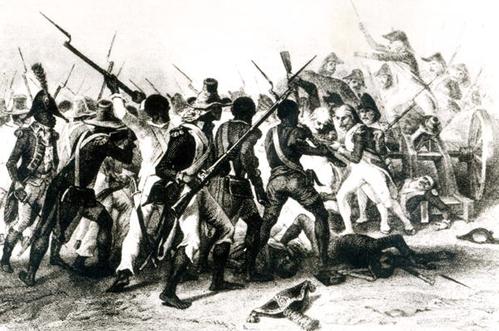
The Battle of Vertières, the last and defining Battle of the Haitian Revolution


View the following materials:
DOCUMENTARY: PBS Egalite for All: Toussaint Louverture and the Haitian Revolution (2009) (55:22 min)
VIDEO: Haiti: The Untold Story - THIS IS WHY HAITI POOR (13:57 min)
Read the following:
After completing this lesson, students
will be able to:


