
Education For Life Academy
Where Black History Lives!

Unit 3: The Trans-Atlantic Slave Trade (1400 – 1865)
The Standing on the Shoulders of Giants Curriculum
Class Overview cont.
Class 4: The Haitian Revolution (1791 – 1804)
Page 2 of 2
The Age of Revolution
In 1789, the outbreak of the French Revolution sparked civil war in Saint- Domingue as various classes within the population (including free people of color) demanded independence, legal rights and citizenship. It was during the French Revolution when new national concepts emerged such as natural rights, liberty, universal rights and individual freedom. Yet, how could the French demand liberty and individual rights and simultaneously support the plundering, enslavement and oppression of African and native populations?
In the spirit of human freedom, African revolutionaries called on their communities to rise up! From 1791 – 1804, Africans fought fiercely against slavery and colonialism and defeated the strongest militaries in the world. After a bloody struggle in which 100,000 Africans and 24,000 whites were killed, Jean-Jacques Dessalines declared independence on January 1, 1804 and renamed the island Haiti (adapted from it’s original Taíno name Ayiti)—which means “Land of Mountains.”
Haiti emerged as a symbol of pride in the African Diaspora, but the Black-led nation paid a severe price. France refused to recognize Haitian independence until it was paid 150 million francs in reparations for “lost property”—the equivalent to $20 billion in today’s economy. In 1838, the “indemnity” was reduced to 90 million francs to be paid over 30 years. Western nations, including the United States, joined together to sanction and isolate Haiti, forcing the country into extraordinary debt and unjust economic relations. For more than 100 years, Haiti paid this debt, plus interest, until its final payment in 1947.
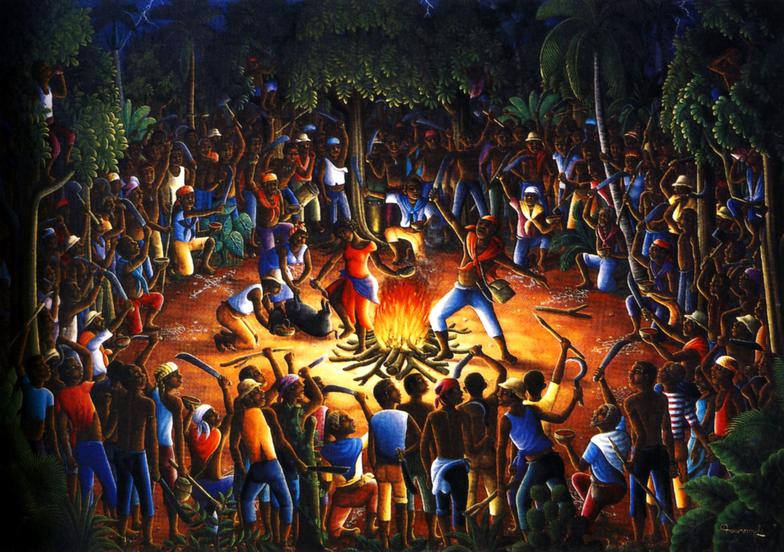
On Aug. 14, 1791, the Haitian Revolution began with the Bois Caïman ceremony, a popular Vodun ceremony. Enslaved people met in the forest to create plans to burn down plantations and start an all-out rebellion.
Lithograph by Maurin after a lost earlier drawing (1838)
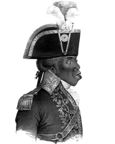
There are no definitive, surviving portraits of Toussaint, so no one knows for sure. Most who described him say he was not a handsome man, but had a powerful presence. Marcus Rainsford, for one, observed: "He is a perfect black...of a venerable appearance, but possessed of uncommon discernment... He wears as a
What did Toussaint look like?
uniform, a kind of blue spencer, with a large red cape falling over his shoulders, and red cuffs with eight rows of lace on his arms, and a pair of large gold epaulettes thrown back on his shoulders; a scarlet waistcoat, pantaloons and half-boots; a round hat with a red feather and national cockade; and an extreme large sward is suspended from his side."
What others have said about Toussaint L'Ouverture:
- "At the head of all is the most active and indefatigable man one can imagine. One can definitely say that he is everywhere and above all in the place where sound judgment and danger lead him to believe that his presence is the most essential. His great sobriety and the ability given only to him of never resting, the advantage he has of going back to office work after a tiresome journey, of replying to a hundred letters a day and of habitually exhausting five secretaries." - Colonel Vincent, in a note to Bonaparte. (Parkinson, p.84)
- Beauchamp said, "His political performance was such that, in a wider sphere, Napoleon appears to have imitated him." (Korngold, p. xi)
- "Toussaint is a Negro and in the jargon of war he is also called a brigand. But we would like to say that this Negro who was born to avenge the outrage to his race has proved that the character of a man has nothing to do with his colour." - The London Gazette, 1798 (Parkinson, p. 84)
- "The role which the great Negro Toussaint, called L'Ouverture, played in the history of the United States has seldom been fully appreciated. Representing the age of revolution in America, he rose to leadership through a bloody terror, which contrived a Negro "problem" for the Western hemisphere, intensified and defined the anti-slavery movement, became one of the causes, and probably the prime one, which led Napoleon to sell Louisiana for a song; and, finally, through the interworking of all these effects, rendered more certain the final prohibition of the slave-trade by the United States in 1807." (Du Bois, p. 70)
-"Without military knowledge he fought like one born in the camp. Without means he carried on the war. He beat his enemies in battle, and turned their own weapons against them. He laid the foundation for the emancipation of his race and the independence of the island." (Wells Brown, p. 104)


