Education For Life Academy
Where Black History Lives!

The Standing on the Shoulders of Giants Curriculum


New Kingdom Map (5 min)
Valley of the Kings (10 min)
EFLA Slideshow: Ancient Egypt: The New Kingdom, Part 1 (10 min)
Supplemental Material
Documentary: Hatshepsut: The Queen Who Would Be King (47:08 min)
Relief & Inscriptions at Karnak Temple Vol. I, UChicago Oriental Institute, edited by James Breasted, 122 pages (this document takes approx. 3-5 mins to download)


Class Overview

After completing this lesson, students
will be able to:

Read/View the following material:
Unit 1: Ancient Africa (200,000 B.C.E. – 476 A.C.E.)
Pharaoh Amenhotep III, reign: 1388 – 1351 B.C.E. and his Royal Wife, Queen Tiye,
co-regency: 1390 – 1353 B.C.E, 18th Dynasty. Amenhotep III and Queen Tiye are the parents of Amenhotep IV, aka Akhenaten, and the grandparents of the famous "King Tut." They ruled at the height of the New Kingdom during the illustrious 18th Dynasty.
Class 10: Ancient Egypt: The New Kingdom and Third Intermediate Period (1550 B.C.E. – 712 B.C.E.)
- Identify the contributions the New Kingdom made to world civilization
- Identify the main Pharaohs of the New Kingdom and their specific accomplishments
- Analyze primary source documents from the New Kingdom to glean insight into ancient Egyptian life and culture
- Discuss the evidence and theories relating to the collapse of the New Kingdom
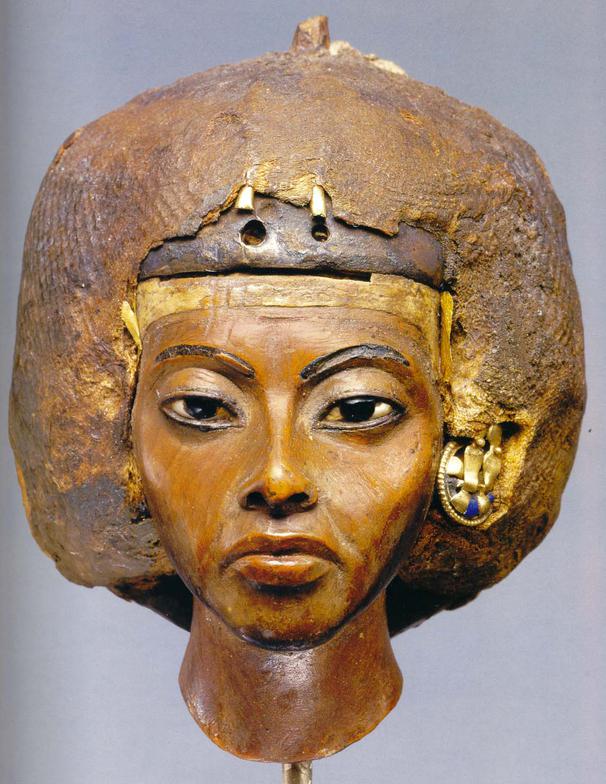
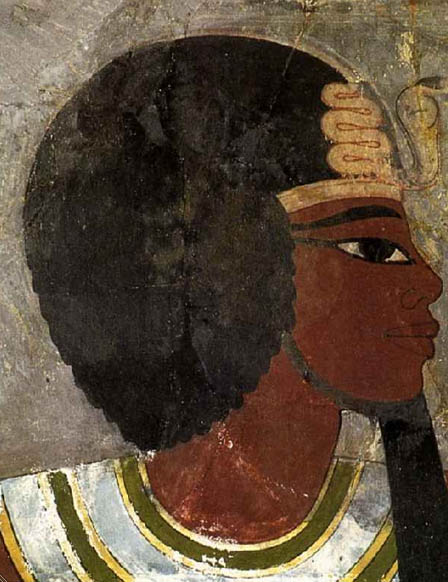

In 2014 PBS released a boldly titled documentary, The Rise of the Black Pharaohs, a reference to the Kushite, or Nubian Pharaohs of the 25th Dynasty who ruled ancient Egypt for over a century. What is insinuated in the title is that the ancient Egyptians themselves were not black. The intent again is to disassociate ancient Egypt from black Africa. Instead, Egyptians are portrayed as a race of people developed independently of any African influence. The images above are of Amenhotep III and Queen Tiye, two of the most venerable Pharaohs and Queens of the New Kingdom, which is considered by many to be the height of the Egyptian Empire. They are clearly black – and African. Egyptians painted and sculpted themselves all the time (in varying shades of black, brown and light skin), they knew the color of their complexion – and that of others. The royal lineage of ancient Egypt was African, and the great pharaohs of the New Kingdom, like those before them, were from the South, and buried in the South, in the sacred Valley of the Kings and Queens.
The New Kingdom began with Ahmose I landing the final blow to the Hyksos's army and once again unifying Upper and Lower Egypt. During the beginning of the New Kingdom, Egyptian Warrior Pharaohs beginning with Seqenenre Tao (17th Dynasty) who initiated the war against the Hyksos, his sons Kamose and Ahmose I, and later Thutmose I, Amenhotep I and Thutmose III, launched military campaigns in Syria and Nubia – not as a form of aggression – but to prevent further war with the ever expanding and aggressive Asiatic, and to a lesser extent Nubian empires. Ancient Egyptian civilization was never imperialistic - it never needed to be. It had everything it needed and what it did not have others brought willingly to exchange for Egyptian goods. Ancient Egypt's motive for invading foreign lands was primarily to weaken them from attacking Egypt, and to form a larger buffer to stave off future attacks. Egypt was simply too power, wealthy and prestigious for foreigners of depressed civilizations to leave alone. Yet once they were in power, foreign rulers such as the Hyksos, Libyans, Assyrians, as well as the Greeks and Romans, often imitated the customs of Egyptian Pharaohs and routinely adopted Egyptian culture instead of bringing their own, acknowledging the supremacy of ancient Egyptian civilization.
The New Kingdom also gave rise to powerful women, such as Pharaoh Hatshepsut, considered one of the greatest pharaohs of all time, who ruled for over 20 years while stewarding the throne for her stepson Thutmose III. She built the an exquisite temple in the reflection of the ruined temple of Mentuhotep II, as well as adding a temple to the great Karnak Temple Complex and two magnificent obelisks. Hatshesut reestablished important trade routes that were
Page 1 of 2