
Education For Life Academy
Where Black History Lives!

The Standing on the Shoulders of Giants Curriculum
Amunhotep IV changed his name to Akhenaten (reign 1353 BC – 1336 BC or 1351–1334 BC) in honor of the Aten. His exclusive worship of the Aten, which began during the fourth year of his reign, changed Egypt's religion from a polytheistic (worship of multiple dieties) religion to a henotheistic religion (worshipping a single god while accepting the existence or possible existence of other deities).
Akhenaten is often misinterpreted as history's first practitioner of monotheism (the belief that only one God exists) and the precursor of Judeo-Christian monotheism. But Akhenaten did did not deny the existence of other gods.
Akhenaten's Great Royal Wife Nefertiti (c. 1370 BC – 1330 BC), played a prominent role in her husband's Aten worship, but is more famous today as the subject of the painted bust portrait, attributed to the sculptor Thutmose, one of the most reproduced works of ancient Egypt.
Found in Thutmose's workshop, the bust exemplifies the realistic portrayals of the Amarna style of painting and sculpture oracticed during the Eighteenth Dynasty. Some scholars believe that Nefertiti ruled briefly after Akhenaten's death and before the accession of Tutankhamun, taking the name Smenkhkare (this identification remains an hypothesis and is a matter of ongoing debate).
Akhenaten's and Nefertiti's religious fervor, which the priests found threatening, is cited as the reason why some of the art and building infrastructure created during Akhenaten's reign was defaced or destroyed in the period following his death and subsequent attempts were made to write him out of Egyptian history. Yet under his reign, during the 14th century BC, Egyptian art flourished in drama, literature and music and attained an unprecedented level of realism painting and sculpture that will forever be associated with his name.
Akhenaten's and Nefertiti's son and successor, Tutankhamun (reign 1333–1324 BC) was nine years old when his father did and became pharaoh and reigned for approximately ten years.
In historical terms, Tutankhamun is significant for his rejection of the religious innovations introduced by Akhenaten and the fact that his tomb (small relative to his status, probably because he died unexpectedly was discovered by archaeologist Howard Carter in the Valley of the Kings almost entirely intact, including the fabulous royal sarchophagus and thousands of objects, which have been exhibited around the world.
Tutankhamun was one of the few kings worshiped as a god and honored with a cult-like following during his short lifetime.
While the cause of the death of "King Tut" may never be known with certainty, the most scientific conclusion to date was made by a team of Egyptian scientists working with Egyptian archaeologist Zahi Hawass, who concluded, ased on CT scans made in 2005, that Tutankhamun died of gangrene after breaking his leg.
Towards the end of the Eighteenth Dynasty, the situation had changed radically. Helped by Akhenaten's apparent lack of interest in international affairs, the Hittites had gradually extended their influence into Syria and Palestine to become a major power in international politics—a power that both Seti I and his son Ramesses (or Ramses) II would need to deal with during the Nineteenth Dynasty.
Ramesses II ("the Great": reign 1279-1213 BC) sought to recover territories in the Levant that had been held by the Eighteenth Dynasty. His campaigns of reconquest culminated in the Battle of Kadesh, on the banks of the Orontes Reiver in Syria, where he led Egyptian armies against those of the Hittite king Muwatalli II and was caught in history's first recorded military ambush. Thanks to the arrival of the Ne'arin (Canaanite mercenaries who swore allegiance to Egypt), Ramesses II rallied his troops and turn the tide of battle against the Hittites. The outcome of the battle was undecided, both sides claiming victory, which ultimately resulted in a peace treaty between the two nations.



The New Kingdom (1550 – 1070) and Third Intermediate Period (1070 – 712 B.C.E.) cont.
Amenhotep I, reign: 1526–1506 B.C.E. He was a son of Ahmose I and Ahmose-Nefertari, but had other siblings and wasn't supposed to rule. Yet his heir apparent died so he inherited the throne. Although he is less known, Amenhotep helped re-consolidate Egyptian power after the brief rule of the Hyksos.

Unit 1: Ancient Africa (200,000 B.C.E. – 476 A.C.E.)
Page 2 of 5
Class 10: Ancient Egypt: The New Kingdom and Third Intermediate Period (1550 B.C.E. – 712 B.C.E.)

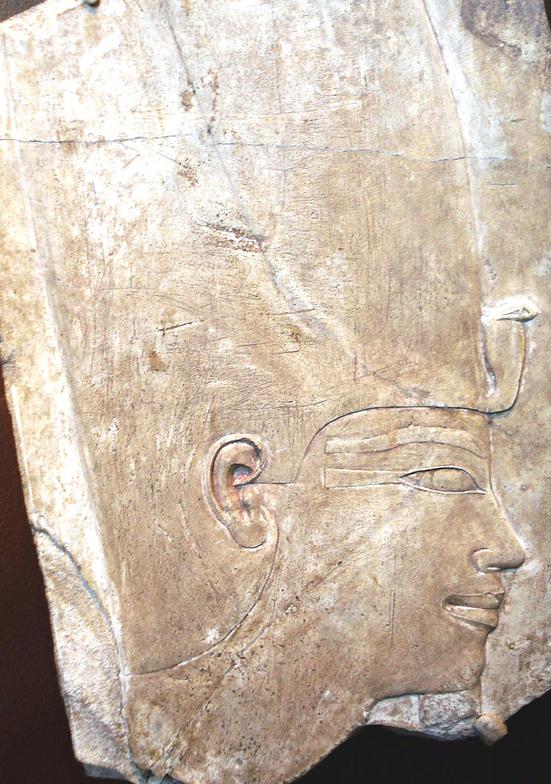
Relief of Amenhotep I from Karnak Temple. Amenhotep ruled in relative peace and was deified upon his death and made the patron deity of the village which he opened at Deir el-Medina. Most depictions of him are from his funerary cult.

