
Education For Life Academy
Where Black History Lives!

The Standing on the Shoulders of Giants Curriculum
With his lesser wife, Kiya, Akhenaten had two sons, Tutankhamun and possibly Smenkhkare (though Smenkhare’s lineage is disputed). Akhenaten married two of these daughters, Meritaten and Ankhesenpaaten (later, Ankhsenamun, wife of Tutankhamun) and may have had children with them (though this is also disputed). What is clear, however, from stele and inscriptions which survived the later purge of their reign, is that the royal couple was deeply devoted to each other and constantly together or with their daughters. Regarding Nefertiti’s physical appearance at this time, Heller writes:
It is surmised that she must have been about four feet, six inches tall, the height of an average Egyptian woman of the time. It is known from her depictions that she often went about scantily dressed, as was customary in the warm climate. Otherwise, she appeared in the traditional garb of a clinging gown tied by a girdle with ends falling in front; at times, she is depicted coiffed with a short wig. She probably had a shaven head to improve the fit of her unusual tall blue crown. It is known that she identified with her husband’s heresy and that, according to Akhenaten’s poetry, he loved her dearly. It is also known that her beauty was legendary (3).
The royal family originally lived at the palace of Malkata in Thebes, which was built under the reign of Amenhotep III but renovated under Akhenaten and re-named Tehen Aten (meaning `the splendor of Aten). The historian Barbara Watterson describes the palace:
The royal apartments were built on an especially grand scale: the king’s bedroom, for example, measured nearly 8 metres by 5 [26 feet by 16.5], and this excludes a raised recess to house the royal bed. The floor in the great hall of the king’s palace was painted to represent a pool in the marshes and that in the palace next door a pool with plants and water birds. The entire ceiling of the great hall was patterned with flying vultures; that of the king’s bedroom with a row of vultures. The ceilings of many rooms in the palace were painted with spirals and interweaving designs, combined with naturalistic forms such as flying birds (151).
Watterson, and others, also point out that the palace was abundant in gold decorations and ornate reliefs. However opulent Malkata was, the new palace at the city the couple founded, Akhetaten, was even grander and, more importantly, served a symbolic purpose in the new religion of Aten. The Egyptologist Zahi Hawass explains:
As part of his religious revolution, Akhenaten decided to leave Thebes and move to a virgin site that would be dedicated to his new cult. The new city was located in Middle Egypt, and called Akhetaten, `Horizon of Aten’. It was laid out parallel to the river, its boundaries marked by stelae carved into the cliffs ringing the site. The king himself took responsibility for its cosmologically significant master plan. In the center of his city, the king built a formal reception palace, where he could meet officials and foreign dignitaries. The palaces in which he and his family lived were to the north, and a road led from the royal dwelling to the reception palace. Each day, Akhenaten and Nefertiti processed in their chariots from one end of the city to the other, mirroring the journey of the sun across the sky. In this, as in many other aspects of their lives that have come to us through art and texts, Akhenaten and Nefertiti were seen, or at least saw themselves, as deities in their own right. It was only through them that the Aten could be worshipped: they were both priests and gods (39).
In her role as part of the divine couple, Nefertiti may also have been co-regent. Akhenaten joined his cartouche (his seal) with hers as a sign of equality and there is evidence that she took on the traditional duties of pharaoh while her husband busied himself with theological reformation and architectural renovations. Images which have survived depict her officiating at religious services, receiving foreign dignitaries, moderating diplomatic meetings, and even in the traditional royal role of the king smiting the enemies of Egypt. None of these images would have been created if there were not some truth behind the stories they depict and so Nefertiti must have wielded more power than any woman in Egypt since the time of Hatshepsut (1479-1458 BCE). From the royal palace at Akhetaten, she sent forth the royal decrees and made the decisions which, according to tradition, were the responsibility of her husband.
Queen Nefertiti

Unit 1: Ancient Africa (200,000 B.C.E. – 476 A.C.E.)
Page 2 of 4
Class 11: Ancient Egypt: The New Kingdom and Third Intermediate Period (1550 B.C.E. – 712 B.C.E.)
Nefertiti worshipping the Aten. She is given the title of Mistress of the Two Lands. On display at the Ashmolean Museum, Oxford.
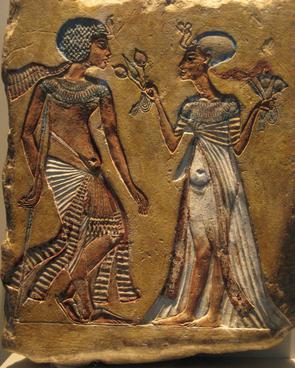
The stelae of “The lovers in the garden” (Staatliche Museen, Berlin).
