
Education For Life Academy
Where Black History Lives!

The Standing on the Shoulders of Giants Curriculum
NEFERTITI’S DISAPPEARANCE
Around the year 14 of Akhenaten and Nefertiti’s reign, their daughter Mekitaten died in childbirth at the age of 13. An image in relief from the time shows the couple standing over their daughter’s body in mourning. Shortly after this, Nefertiti vanishes from the historical record. There have been many theories offered to explain her abrupt disappearance and, among these are:
She fell out of favor with her husband because she could not produce a male heir and so was replaced by Kiya.
- She abandoned the religion of Aten and was banished by Akhenaten.
- She committed suicide in grief over the loss of her daughter.
- She continued to rule under the name of Smenkhkare until her step-son, Tutankhamun, was old enough to assume the throne.
Of these theories, none of them can be substantiated but the fourth, and even that, many argue, is uncertain. The leading proponent of the Nefertiti-as-Smenkhkare theory is Zahi Hawass who writes:
This king [Smenkhkare] is shown as a male in the company of Meritaten as `his’ queen; however, his throne name was virtually identical to that of Akhenaten’s coregent, now convincingly identified as Nefertiti. Whether this king was Nefertiti herself or an otherwise unattested son of Akhenaten’s (or Amenhotep III’s) he or she died only two years after ascending the throne, and left Egypt in the hands of a young boy named Tutankhaten [later Tutankhamun] (47).
The problems with the other theories are that Akhenaten already had a male heir in Tutankhamun and so would not have deserted his wife on that account (theory one); there is no evidence to support Nefertiti leaving the cult of Aten (theory two); she was still living after the death of her daughter and the throne name of Akhenaten’s successor is the same as hers (theory three). The reason why theory two has long remained popular is because of evidence that the worship of the old gods began to revive toward the end of Akhenaten’s reign and, it is thought, this could not have happened without some kind of royal support or encouragement.
Since it is considered impossible that Akhenaten would have abandoned the religion he created, it is speculated that it was his coregent who was behind this. The revival of the old religious practices, however, could easily have been a grassroots movement by the people of Egypt who had grown tired of being forced to neglect the traditional faith of the land. The Egyptians held that their actions were intimately tied to celestial balance and that their relationship with the gods was of vital importance. In abandoning the old gods of Egypt, Akhenaten would have thrown the universe out of balance and it is quite likely that the former priests of Amun, and those of other cults, finally decided to try to restore harmony to the land on their own, without consulting their ruler. Since it is known that Nefertiti was a devotee of Aten prior even to Akhenaten’s conversion, and that she regularly took part in religious services, as well as the fact that no images or inscriptions give any evidence that she forsook the cult, it is highly unlikely that she would have led a return to the traditional religious practices of Egypt.
The hatred the people had for the new monotheistic religion of their pharaoh is exemplified in its complete eradication after the death of Akhenaten’s successor Tutankhamun. Tutankhamun himself, upon taking the throne, abandoned the religion of Aten and returned Egypt to traditional practice. His successor, Ay, (possibly the same man suggested as Nefertiti’s father) continued his policies but the last pharaoh of the 18th dynasty, Horemheb, went further than either of them. Horemheb, claiming he had been chosen by the gods to restore the true religion of Egypt, tore down Akhenaten’s temples, defaced his stele, and tried to eradicate all evidence that the heretic king and his family had ever ruled Egypt. It is because of Horemheb’ s decrees that so little is known of Nefertiti, and other royals linked with the Amarna Period, in the present day. The wonder, really, is not that so little is known but that, considering Horemheb’s hatred of Akhenaten’s reforms, and his dedication to the mission of erasing the king and his family from history, that modern day scholars have any information on the Amarna Period at all.
Queen Nefertiti
Relief of Queen Nefertiti, Brooklyn Museum

Unit 1: Ancient Africa (200,000 B.C.E. – 476 A.C.E.)
Page 3 of 4
Class 11: Ancient Egypt: The New Kingdom and Third Intermediate Period (1550 B.C.E. – 712 B.C.E.)
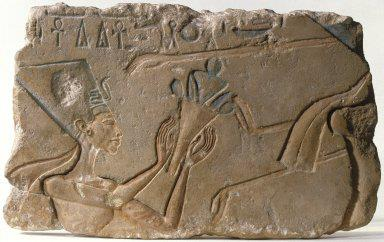
Close-up of a limestone relief depicting Nefertiti smiting a female captive on a royal barge. On display at the Museum of Fine Arts, Boston.
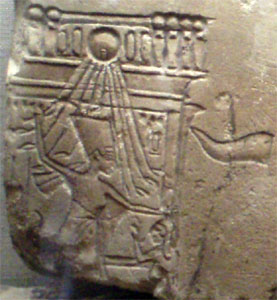
Nefertiti worshipping the Aten. She is given the title of Mistress of the Two Lands. On display at the Ashmolean Museum, Oxford.

