
Education For Life Academy
Where Black History Lives!

The Standing on the Shoulders of Giants Curriculum


Queen of Sheba, Encyclopedia of World Biography (10-15 min)
Documentary: Queen of Sheba - Black (African), Arab (mixed/white) or both (Semite)? (21:59 min)
The Queen of Sheba, Wikipedia excerpts. (15-20 mins) Grades 7+.
Bonus Video: Dr. Yosef Ben Jochannan on Queen Makeda, Solomon, Menelik, Kebra Negast...(8:10 mins) Grades 9+
Additional Resources:
History Channel Documentary - The Queen of Sheba (1:19 mins)


Class Overview

After completing this lesson, students
will be able to:

Read/View the following material:
Unit 1: Ancient Africa (200,000 B.C.E. – 476 A.C.E.)
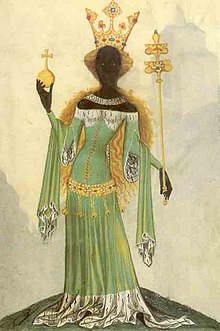
The Queen of Sheba, from a 15th-century manuscript now at Staatsund Universitätsbibliothek Göttingen.
Class 13: The Queen of Sheba & Solomon (10th Century B.C.E. – 955 B.C.E.)
- Discuss the story of the Queen of Sheba and her encounter with King Solomon as told in the Bible, The Quran, and the Kebra Nagast.
- Recognize the influence Africa and African women have had in the development of Judaism, Christianity, Islam, and world history.
- Scrutinize the racial and religious propaganda associated with the story of the Queen of Sheba, including her racial identity.
- Locate Ethiopia, the home of the Queen of Sheba, and the Kingdom of Sheba on a map.

The Queen of Sheba is one of the most famous queens of antiquity and her affair with King Solomon is one of the most celebrated stories in religious mythology. What is particularly noteworthy today about the story of Solomon and the Queen of Sheba is that the Queen of Sheba is African/Black and King Solomon is Hebrew/White. Racism is a modern idea. It did not exist before the Trans-Atlantic Slave Trade, or the African Holocaust as some refer to it. During the times of the Queen of Sheba Africans were held in high esteem as their genius was demonstrated through their numerous kingdoms in Africa and abroad, including ancient Kemet/Egypt, Nubia and ancient Ethiopia. King Solomon, one of the wisest men in the Bible, was so intrigued by the Queen of Sheba that he tricked her into submitting to him, which resulted in her giving birth to his first-born son, Ebna Hakim or Menelik I. Would one of the wisest men in the world be so intrigued by someone who is “racially” inferior to him? Would he go out of his way to have a child with her? The story of the Queen of Sheba stands as testimony to the vaulted place Africans held in the world for thousands of years before the Trans-Atlantic Slave Trade. It also demonstrates the respect and power African women held in African societies. Nowhere else in the ancient world did women achieve such equality or power.
The Queen of Sheba is first mentioned in the Old Testament of the Bible in I Kings 10:1–14 and in a nearly word-for-word repetition, 2 Chronicles 9:1–12. Her story is retold with variation in the Quran and the Kebra Nagast, a 14th century Ethiopian religious text translated by English Egyptologist Wallis Budge, as The Glory of the Kings. Outside of these texts, little is known about the Queen of Sheba. There are no images of her and no one knows for certain the full extent of the her kingdom. However, in Biblical text, she is referred to as the Queen of Ethiopia. This would not only make her kingdom to at least be partially in Africa, but it also makes her African. Yet, virtually all of the mainstream images of the Queen of Sheba depict her as white with little exception. In fact, you will find no images of the Queen of Sheba painted by Black or African artists on Wikipedia or on a random Google search. I was amazed to find the Black image of her pictured above, which was actually painted by a white artist.
The Kingdom of Sheba is believed to be in Ethiopia and Yemen. As a result, the people from Yemen claim that the Queen of Sheba was from Yemen and that the kingdom of Sheba was in present day Yemen. Yet, the Bible clearly states that she is from Ethiopia. It never mentions Yemen or Arabia as her place of origin albeit her kingdom may have stretched to Yemen. Conversely, the Ethiopians claim that the Queen of Sheba was their very own Queen Makeda, who after her famous meeting with Solomon, conceived a son by him, Menelik I or Ebna Hakim. They consider Menelik I to be the father of their dynasty that ended in 1974 with the overthrow of emperor Haile Selassie.
Page 1 of 2


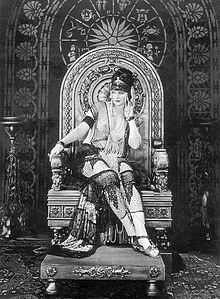
Betty Blythe as the queen in The Queen of Sheba (1921).
