Education For Life Academy
Where Black History Lives!

The Standing on the Shoulders of Giants Curriculum


Queen of Sheba Wikipedia Excerpts cont.
Menelik I, the first Solomonic Emperor of Ethiopia, is traditionally believed to be the son of King Solomon of ancient Israel and Makeda, ancient Queen of Sheba. He is alleged to have ruled around 950 BC, according to traditional sources.Tradition credits him with bringing the Ark of the Covenant to Ethiopia, following a visit to Jerusalem to meet his father upon reaching adulthood.
According to the Kebra Nagast, King Solomon had intended on sending one son of each of his nobles and one son of each temple priest with Menelik upon his return to his mother's kingdom. He is supposed to have had a replica made of the Ark for them to take with them. Upon the death of Queen Makeda, Menelik assumed the throne with the new title of Emperor and King of Kings of Ethiopia.
According to legend, he founded the Solomonic dynasty of Ethiopia that ruled Ethiopia with few interruptions for close to three thousand years (and 225 generations later ended with the fall of Emperor Haile Selassie in 1974).

Unit 1: Ancient Africa (200,000 B.C.E. – 476 A.C.E.)
Class 13: The Queen of Sheba & Solomon (10th Century B.C.E. – 955 B.C.E.)
Christian Account
Christian scriptures mention a "queen of the South," who "came from the uttermost parts of the earth", i.e. from the extremities of the then known (Christian) world, to hear the wisdom of Solomon (Mt. 12:42; Lk. 11:31).
The mystical interpretation of the Canticles, which was felt of supplying a literal basis for the speculations of the allegorists, makes its first appearance in Origen, who wrote a voluminous commentary on the Canticles. In his commentary, Origen identified the bride of the Canticles with the "queen of the South" of the Gospels, i. e. the Queen of Sheba, who is assumed to have been Ethiopian. Others have proposed either the marriage of Solomon with Pharaoh's daughter, or his marriage with an Israelitish woman, the Shulamite. The former was the favorite opinion of the mystical interpreters to the end of the 18th century; the latter has obtained since its introduction by Good (1803)
The bride of the Canticles is assumed to have been black due to a passage in Cant. 1:5, which the Revised Standard Version (1952) translates as "I am verydark, but comely", as does Jerome (Latin: Nigra sum, sed formosa), while the New Revised Standard Version (1989) has "I am black and beautiful", as the Septuagint.
Jewish Account
According to Josephus (Ant. 8:165–73), the queen of Sheba was the queen of Egypt and Ethiopia, and brought to Israel the first specimens of the balsam, which grew in the Holy Land in the historian's time. Josephus (Antiquities 2.5-2.10) represents Cambyses as conquering the capital of Aethiopia, and changing its name from Seba to Meroe. Josephus affirms that the Queen of Sheba or Saba came from this region, and that it bore the name of Saba before it was known by that of Meroe. There seems also some affinity between the word Saba and the name or title of the kings of the Aethiopians, Sabaco.
The Talmud (Bava Batra 15b) insists that it was not a woman but a kingdom of Sheba (based on varying interpretations of Hebrew mlkt) that came to Jerusalem, obviously intended to discredit existing stories about the relations between Solomon and the Queen. Baba Bathra 15b: "Whoever says malkath Sheba (I Kings X, 1) means a woman is mistaken; ... it means the kingdom of Sheba".
Page 3 of 3

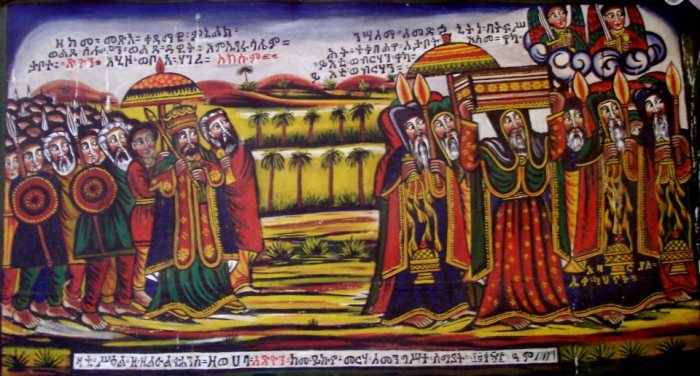
Painting in the new church of 'St Mary of Zion' showing the Ark being carried to Ethiopia by King Menelik.