Unit 1: Ancient Africa (200,000 B.C.E. – 476 A.C.E.)
The Standing on the Shoulders of Giants Curriculum
Class Overview
Class 2: Out of Africa – The Origins of Humanity Part 2
Education For Life Academy
Where Black History Lives!



Read/View the following:
Video: Journey of Man - The Story of the Human Species Part 2 (start at 57:10 min)
The pros and cons of dating a Neanderthal (7- 10 min)
(7 - 10 min)
Supplemental Material: BBC: Modern humans and Neanderthals 'interbred in Europe' (10 minutes)


After completing this lesson, students
will be able to:
- Analyze and acknowledge the prevailing scientific theories on the origins of human beings
- Describe the reasons the first humans (homo sapiens) migrated out of Africa
- Discuss the contributions to civilization made by the first humans in Africa
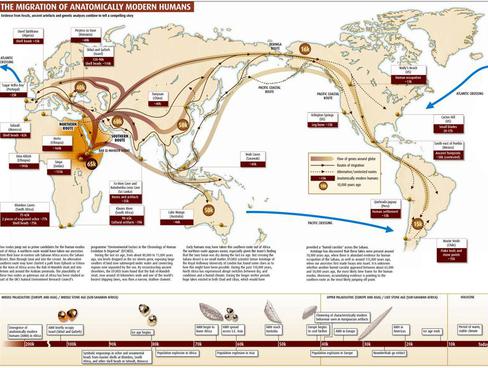
- Chart the path of human migration out of Africa and discuss its impact on human variation (i.e. skin/eye color, height, hair texture, etc.)

For decades, Black scholars have upheld Africa as the “cradle of civilization” and the “birthplace of humanity.” In the face of archeological evidence and historical artifacts, scientists, historians and anthropologists continued to debate, and in many cases deny, this “Out of Africa” theory. Recent advances in genetic studies over the past ten years have firmly put these debates to rest. Without a shadow of doubt, DNA confirms what Black scholars had argued without the seal of genetics—that Africa is the origin of the modern human species.
But what happened to human populations once small groups migrated from Africa to other parts of the world? How did migrations out of the African continent produce the diverse and varied populations we see today? Even as scientists widely acknowledged African origins of humanity, the process of human development outside of Africa continued to generate controversial debates.
Part 2 of the The Journey of Man sheds light on what happened to human populations once they migrated from Africa to other parts of the world. Although the documentary is rooted in a scientific study that confirms a single African origin of humanity, its primary focus is to chronicle the “journey of Europeans”—particularly their ancestral roots in central Asia. At the center of this journey is the discovery that early Europeans interbred with Neanderthals thousands of years after any Africans left Africa. Other studies have affirmed that populations from Europe, China, and New Guinea have up to 2.7% Neanderthal DNA, yet modern African populations have zero. What is this significance of this discovery in relation to modern human differences?
The documentary continues to follow the migration of human beings from Asia and Europe to the Western Hemisphere where the migration ends at the bottom of South America.
Whether the evidence stems from archeology, historical documents, or science, “facts” are routinely debated and denied. The key is to examine the evidence for one’s self, and to think critically about interpretations. After viewing these sources, what is your interpretation of what it all means?


Page 1 of 1