
Education For Life Academy
Where Black History Lives!

The Standing on the Shoulders of Giants Curriculum


Second Intermediary Period (1650 – 1550 B.C.E.)
Page 1 of 2
The Second Intermediate Period marks a period when Ancient Egypt fell into disarray for a second time, between the end of the Middle Kingdom and the start of the New Kingdom.
It is best known as the period when the Hyksos made their appearance in Egypt and whose reign comprised the Fifteenth dynasty.
End of the Middle Kingdom
The brilliant Egyptian twelfth dynasty came to an end at the end of the 19th century BC with the death of Queen Sobekneferu (1806–1802 BC). Apparently, she had no heirs, causing the twelfth dynasty to come to a sudden end, and, with it, the Golden Age of the Middle Kingdom; it was succeeded by the much weaker thirteenth dynasty of Egypt. Retaining the seat of the twelfth dynasty, the thirteenth dynasty ruled from Itjtawy ("Seizer-of-the-Two-Lands") near Memphis and el-Lisht, just south of the apex of the Nile Delta.
The thirteenth dynasty is notable for the accession of the first formally recognised Semitic king, Khendjer. The thirteenth dynasty proved unable to hold on to the entire territory of Egypt, however, and a provincial ruling family of Canaanite descent in Avaris, located in the marshes of the eastern delta, broke away from the central authority to form the fourteenth dynasty.
Fifteenth Dynasty
The Fifteenth Dynasty dates approximately from 1650 to 1550 BC. Known rulers of the Fifteenth Dynasty are as follows:
Salitis
Sakir-Har
Khyan
Apophis, c. 1590? BC-1550 BC
Khamudi, c. 1550-1540 BC
The Fifteenth Dynasty of Egypt was the first Hyksos dynasty, ruled from Avaris, without control of the entire land. The Hyksos preferred to stay in northern Egypt since they infiltrated from the north-east. The names and order of kings is uncertain. The Turin King list indicates that there were six Hyksos kings, with an obscure Khamudi listed as the final king of the Fifteenth Dynasty. The surviving traces on the X figure appears to give the figure 8 which suggests that the summation should be read as 6 kings ruling 108 years.
Some scholars argue there were two Apophis kings named Apepi I and Apepi II, but this is primarily due to the fact there are two known prenomens for this king: Awoserre and Aqenenre. However, the Danish Egyptologist Kim Ryholt maintains in his study of the Second Intermediate Period that these prenomens all refer to one man: Apepi I who ruled Egypt for 40+X years. This is also supported by the fact that this king employed a third prenomen during his reign: Nebkhepeshre Apophis likely employed several different prenomens throughout various periods of his reign. This scenario is not unprecedented, as later kings, including the famous Ramesses II and Seti II, are known to have used two different prenomens in their own reigns.
Sixteenth Dynasty
The Sixteenth Dynasty ruled the Theban region in Upper Egypt for 70 years.
Of the two chief versions of Manetho's Aegyptiaca, Dynasty XVI is described by the more reliable Africanus (supported by Syncellus) as "shepherd [hyksos] kings", but by Eusebius as Theban.
Ryholt (1997), followed by Bourriau (2003), in reconstructing the Turin canon, interpreted a list of Thebes-based kings to constitute Manetho's Dynasty XVI, although this is one of Ryholt's "most debatable and far-reaching" conclusions.

Unit 1: Ancient Africa (200,000 B.C.E. – 476 A.C.E.)
Class 9: Ancient Egypt: Second Intermediary Period (1650 B.C.E. – 1550 B.C.E.)
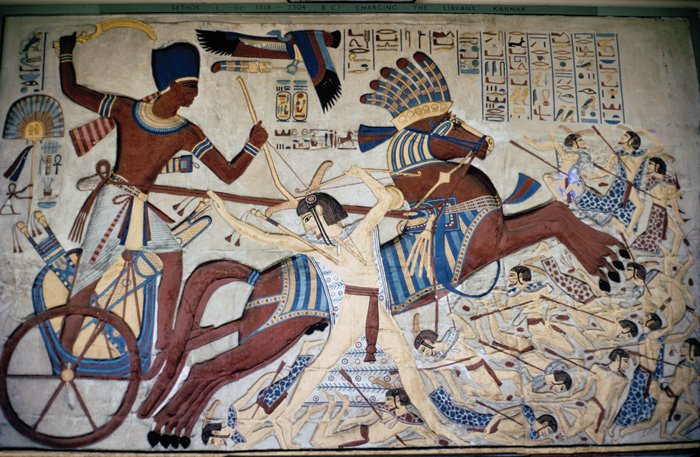
Mural of Egyptian pharaoh battling the Hyksos using the horse-drawn chariot introduced to Egypt by the Hyksos.
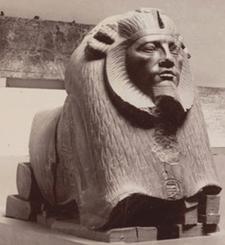
Hyksos King Apepy I - 16th Dynasty
Apepa probably had the longest reign of all Hyksos kings. His personal name Apepy (Greek: Apopis) was obviously taken from the Egyptian god Apep and his throne name means - "Great and Powerful Like Re". He's believed to have been a well educated ruler who got into a war he was strongly opposed to.
He probably triggered it himself by sending a provocative letter (now in British Museum) where he addresses the Egyptian king Tao II in Thebes with a complaint that was really odd. He wrote that he couldn't sleep at night because he was disturbed by the snoring and roaring of king Tao's hippopotami in Thebes 800 km to the south! Soon after this message, king Tao is believed to have taken up arms against him and thereby the war of liberation was started. It's quite possible that his power at this late state of his reign had been going over to others, and the letter was a product of their will, and not his own. Manetho (by Flavius) gives him a 36 yearlong reign and scholars of today up to 42 years to around 1600-1559 B.C.E.

