Education For Life Academy
Where Black History Lives!

The Standing on the Shoulders of Giants Curriculum



Ancient Egypt: Second Intermediate Period (1650 – 1550 B.C.E.)

Page 2 of 2
For this reason other scholars do not follow Ryholt and see only insufficient evidence for the interpretation of the Sixteenth Dynasty as Theban.
The continuing war against Dynasty XV dominated the short-lived 16th dynasty. The armies of the 15th dynasty, winning town after town from their southern enemies, continually encroached on the 16th dynasty territory, eventually threatening and then conquering Thebes itself. In his study of the second intermediate period, the egyptologist Kim Ryholt has suggested that Dedumose I sued for a truce in the latter years of the dynasty, but one of his predecessors, Nebiryraw I, may have been more successful and seems to have enjoyed a period of peace in his reign.
Famine, which had plagued Upper Egypt during late 13th dynasty and the 14th dynasty, also blighted the 16th dynasty, most evidently during and after the reign of Neferhotep III.
From Ryholt's reconstruction of the Turin canon, 15 kings of the dynasty can now be named, five of whom appear in contemporary sources. While most likely rulers based in Thebes itself, some may have been local rulers from other important Upper Egyptian towns, including Abydos, El Kab and Edfu. By the reign of Nebiriau I, the realm controlled by the 16th dynasty extended at least as far north as Hu and south to Edfu. Not listed in the Turin canon (after Ryholt) is Wepwawetemsaf, who left a stele at Abydos and was likely a local kinglet of the Abydos Dynasty.
Ryholt gives the list of kings of the 16th dynasty as shown in the table below. Others, such as Helck, Vandersleyen, Bennett combine some of these rulers with the Seventeenth dynasty of Egypt. The estimated dates come from Bennett's publication.
Seventeenth Dynasty
Around the time Memphis and Itj-tawy fell to the Hyksos, the native Egyptian ruling house in Thebes declared its independence from Itj-tawy, becoming the Seventeenth Dynasty. This dynasty would eventually lead the war of liberation that drove the Hyksos back into Asia. The Theban-based Seventeenth Dynasty restored numerous temples throughout Upper Egypt while maintaining peaceful trading relations with the Hyksos kingdom in the north. Indeed, Senakhtenre Ahmose, the first king in the line of Ahmoside kings, even imported white limestone from the Hyksos-controlled region of Tura to make a granary door at the Temple of Karnak. However, his successors — the final two kings of this dynasty — Seqenenre Tao and Kamose are traditionally credited with defeating the Hyksos in the course of the wars of liberation. With the creation of the Eighteenth Dynasty around 1550 BC the New Kingdom period of Egyptian history begins with Ahmose I, its first pharaoh, completing the expulsion of the Hyksos from Egypt and placing the country, once again, under centralised administrative control.
Source: wikipedia

Unit 1: Ancient Africa (200,000 B.C.E. – 476 A.C.E.)
Class 9: Ancient Egypt: Second Intermediary Period (1650 B.C.E. – 1550 B.C.E.)
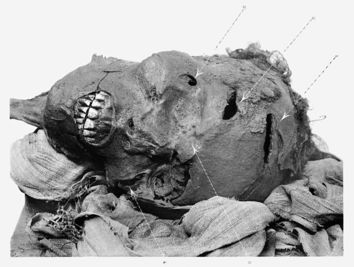
Kamose (reign 1555–1550 BC) was the last king of the Theban 17th Dynasty. He was possibly the son of Seqenenre Tao and Ahhotep I and the full brother of Ahmose I, founder of the Eighteenth Dynasty.
His reign is important for the decisive military initiatives he took against the Hyksos, who had come to rule much of Ancient Egypt. His father had begun the initiatives and, quite possibly, lost his life in battle with the Hyksos. It is thought that his mother, as regent, continued the campaigns after the death of Kamose and that his full brother made the final conquest of them and united all of Egypt.