Education For Life Academy
Where Black History Lives!

The Standing on the Shoulders of Giants Curriculum


(15 - 20 min)
25th Dynasty Map (5 min)
Twenty Fifth Dynasty of Egypt (25-30 min)
Slideshow: The 25th Nubian Dynasty (10 min)
Video: Tomb of Queen Qalhata (4 min)
(15 min)


Class Overview
- Analyze the rise and fall of the 25th Dynasty.
- Discuss the significance of the 25th Dynasty (the “Nubian” Dynasty), and its relationship to and impact on ancient Egyptian society and the Bible.
- Recognize the pharaohs of the 25th Dynasty and their accomplishments.
- Chart the final fall of the ancient Egyptian empire from indigenous Egyptian and African rule to permanent foreign rule beginning with the Persians followed by the Greeks and Romans.

Page 1 of 2
After completing this lesson, students
will be able to:

Read/View the following material:
Unit 1: Ancient Africa (200,000 B.C.E. – 476 A.C.E.)
Class 14: Ancient Egypt: The 25th Nubian Dynasty & Late Period (760 B.C.E. – 332 B.C.E.)
Detail from the Shrine of Taharqa at Nurri, Nubia. Taharqa, also known as the Savior of Jerusalem, was perhaps the last great indigenous king of ancient Egypt.

Recommended websites: The Shrine of Taharqa
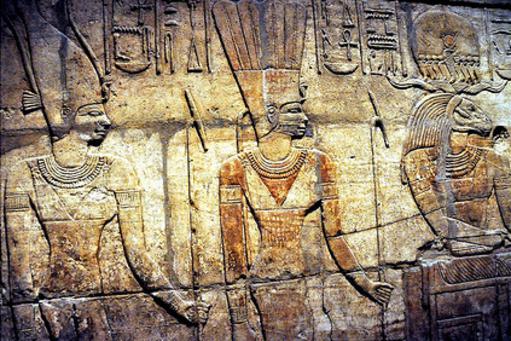
The 25th Dynasty of ancient Egypt, also referred to as the Kushite, or Nubian Dynasty, represents the last great epoch of indigenous rule of ancient Egypt. Although some scholars attribute this distinction to the 26th Dynasty who ruled from Sais. However, these Libyan kings were under the influence of the Assyrians, who helped them rule over Lower Egypt until they were finally strong enough to also conquer Upper Egypt, effectively ending the rule of the 25th Dynasty and its Nubian kings. Thus, it is the 25th Dynasty that stands as the last Dynasty to uphold the independence of Ancient Egypt from outside influence.
With the reunification of Lower and Upper Egypt and the Nubian empire under its control, the 25th Dynasty created the largest Egyptian empire since the New Kingdom. “They ushered in an age of renaissance by reaffirming Ancient Egyptian religious traditions, temples, and artistic forms, while introducing some unique aspects of Kushite culture.” Through the famous “Shabaka Stone,” for instance, Pharaoh Shabaka sought to preserve the ancient wisdom of Old Kingdom religious philosophy, demonstrating a reverence and spiritual relationship to the founders of the ancient Egyptian empire. The Stone also reveals that 25th Dynasty Pharaohs knew how to read ancient Old Kingdom hieroglyphics, further affirming their cultural kinship to the founders of the ancient Egyptian civilization. Furthermore, the kings of the 25th Dynasty repaired and rebuilt temples throughout the empire and built the first pyramids since the Middle Kingdom. Pharaoh Taharqa, perhaps the most well known of the 25th Dynasty Pharaohs, is responsible for much of Egypt’s new renaissance.
Respectful of Egypt's cultural heritage, Taharqa set out to draw on the traditions of the Old and Middle Kingdoms, using new materials (previous Intermediate Period cash-strapped kings had taken to pilfering stone from older buildings) to restore and build anew. In the kingdom of Napata, he built in every important site: Sanam, Napata, Abu Dom, and Kawa. In Kawa particularly, he rebuilt and expanded a temple complex that became the second most important in Kush. In Egypt, it’s at Karnak that he made the greatest impact, thanks to the man he installed as Mayor of the City: the great Nubian Mentuemhet, a man who took an extraordinary pride out of his title as a fourth prophet to Amon. At Karnak, the Sacred Lake structures, the kiosk in the first court, and the colonnades at the temple entrance are all owed to Taharqa and Mentuemhet. Memphis, the capital of the Old Kingdom and royal residence of Kushite kings also received much attention, respecting the importance of Ptah, despite the Kushite's devotion to Amun.
In regards to his military exploits, it is noted by the Ancient Greek historian Strabo that that Taharqa had “’Advanced as far as Europe’, and (citing Megasthenes), even as far as the Pillars of Hercules in Spain.”