
Education For Life Academy
Where Black History Lives!

The Standing on the Shoulders of Giants Curriculum




Class Overview

- Compare and contrast the rule of Egypt under the Greeks vs. the Romans.
- Analyze the ways in which the Greeks and Romans were influenced by Egyptian religion and culture and vice versa.
- Discuss the role Egypt and Africa played in the early formation of Christianity.
- Analyze an eyewitness account of a famous historical event.



Page 1 of 2
After completing this lesson, students
will be able to:

Read/View the following material:
Unit 1: Ancient Africa (200,000 B.C.E. – 476 A.C.E.)
Class 14: Ancient Egypt: Greco-Roman Period (332 B.C.E. – 476 A.C.E.)
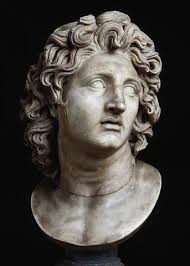
Alexander the Great, the first Macedonian/Greek conquer of ancient Egypt (reign: 332 BC - 323 BC)

Advanced reading: Ancient Egypt Under Greek and Roman Rule (8 pg. 25 - 30 min)
Egypt Under the Greeks (332 BC – 30 BC)
Greeks had been coming to Egypt since the 7th century BCE. Even by then, ancient Egypt had experienced over 2,000 years of native rule and three Golden Ages that brought the world its first marvels of architecture, the understanding of math, astronomy, philosophy as well as the development of religion, paper and writing, and government. In essence, by the time the Greeks get to Egypt it is a shell of itself. Yet and still, the Greeks were in awe of what they saw and learned.
Herodotus was there in the middle of the 5th century BCE and claimed that the Greeks were the first foreigners to ever live in Egypt. However, we know that this is untrue. Those from the Levant lived in ancient Egypt for over a thousand years before the Greeks. However, the Greeks were marveled by Egypt and its most prominent philosophers, mathematicians, scientists, and doctors studied there.
The Greek occupation of Egypt began in 332 with Alexander the Great of Macedonia, who defeated the unwanted Persians. He was received as a liberator. He respected the ancient religion and culture of the Egyptians and proclaimed himself pharaoh after visiting the oracle of Ammon in 331, who proclaimed him the son of Amun-Re. The oracle of Ammon is in the Libyan Desert; no Egyptian pharaoh had ever visited the oracle prior to Alexander. Yet the oracle of Ammon was well respected by the Greeks. Ancient Greek authors ranked it third in importance after the sanctuaries of Zeus at Olympia, the home of the Ancient Olympic Games, and the sanctuary of Zeus in Dodona. Alexander used his visit and anointment by the oracle of Ammon to legitimize his position as pharaoh of Egypt. However, Alexander appeared to actual believe that he was the son of Ammon/Zeus toward the end of his life, capturing his deep fascination with ancient Egyptian religion and culture.
Alexander founded the city of Alexandria to supersede Naucratis as a Hellenistic center in Egypt, and to be the link between Greece and the rich Nile valley. Alexandria is strategically located on the Mediterranean and became the principal city of Greek influence in Egypt. To sum up his love of Egypt, Alexander was buried in Egypt. He was first buried in Memphis, and in the late 4th or early 3rd century BCE his body was transferred from Memphis to Alexandria, where it was reburied.
After the death of Alexander the Great, one of his top companions and generals, Ptolemy I Sotor (Savior) was able to wrestle control of the empire in 323 BCE.

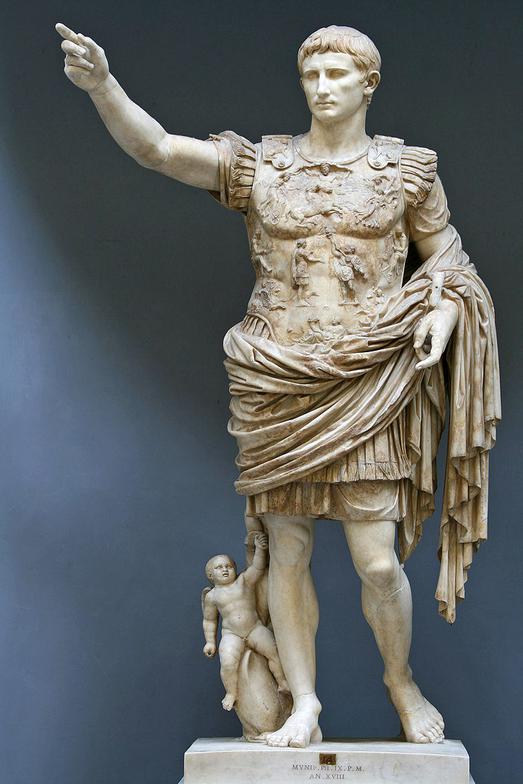
Augustus Octavius Caesar, founder of the Roman Empire and its first Emperor
(reign: 27 BC - 14 AD)
